Travel Stocks in the Covid Era — The Robinhood Effect
Travel companies hit hardest by COVID-19 are slowly recovering. We look at how Delta, Marriott, Carnival, Uber and Booking Holdings have fared in the stock market, and how each has responded to the pandemic.
Robindhood Travel Destination in Stock Market — Robinhood Investors and Travel Stocks in the Covid Era
Travel-related companies such as airlines and hotels, which suffered the most from COVID-19, are slowly coming back to life. European countries, whose travel doors were firmly shut and which took a heavy blow because of the virus, began accepting international tourists again in July. It will take time for the travel industry to recover to pre-COVID levels, but some say the worst is behind us. How have America’s leading travel companies changed during the pandemic? Let’s look at how their stock prices have moved and how each is responding to COVID.
Words Shin Hyeri
www.youtube.com/c/%EB%89%B4%EC%8A%A4%ED%8F%AC%ED%84%B0
Stock Price Changes Before and After the Pandemic in the US
Changes in stock prices before and after the US pandemic
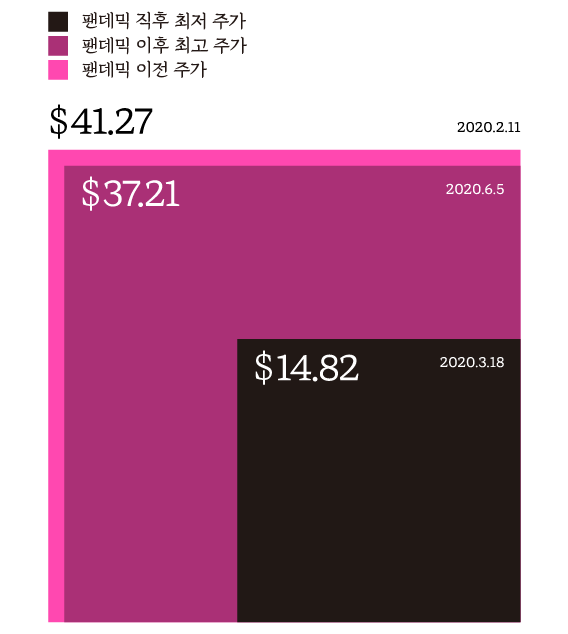
The US stock market underwent major changes around the lockdown measures of mid-March. The chart below compares the lowest and highest share prices recorded over the six months after the pandemic hit, using prices from early 2020, before the pandemic’s impact, as the baseline. The lifting of lockdowns in May, a steady rise in buy-the-dip demand, and the measures each company took to cope with the pandemic all helped prices recover.
Delta Air Lines
Delta Air Lines
Warren Buffett, known as a master investor, dumped all of his airline stocks as soon as the COVID pandemic began in earnest. “The future of the airline industry is very uncertain. I don’t know whether people will fly as much as they used to even three or four years from now,” he said, selling about $6 billion worth of airline shares. Airline stocks then rose instead, as individual investors began buying the dip, expecting that aviation would be one of the first industries to recover once COVID ended.
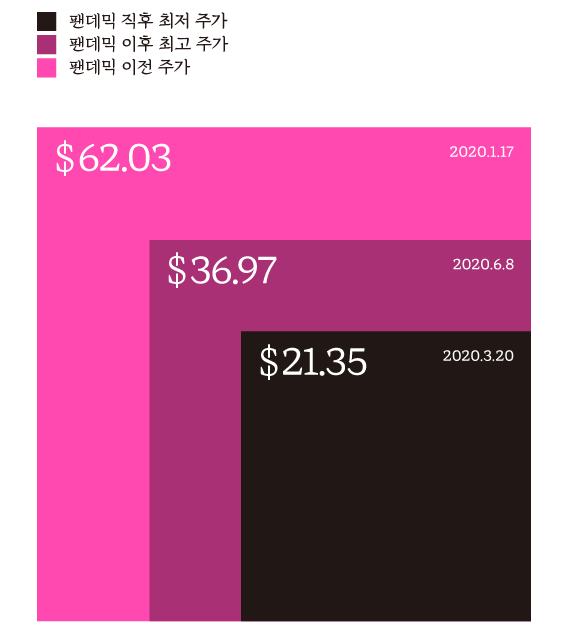
Delta’s stock stood at $60 on January 2 but fell to about a third of that once the pandemic began. Yet thanks to the individual investors who started buying the dip, it rebounded from $22.22 a share on March 23 to $35 a share just three days later.
Because people in the US were simply unable to leave their homes during the lockdown, nearly all airline operations came to a halt. As a result, Delta posted a net loss of $534 million in the first quarter. In the first quarter of last year it recorded a net profit of $730 million, which shows how heavy the COVID blow was. Delta ultimately weathered the losses by cutting labor costs, including temporarily laying off about 2,600 pilots, and the news sent its stock back down to the low $20s.
From May, things gradually improved. After the lockdown was lifted, the government eased restrictions so that truly necessary trips and business travel became possible. Delta became the first US airline to resume service to China and announced that it would restart its Seattle–Shanghai route in July. It also plans to add domestic flights for the summer vacation season and gradually increase international flights beyond China. On this news, the stock rose 70% from the end of May, reaching $37 a share as of June 9. Even so, it appears it will take considerable time for international travel demand to recover to pre-COVID levels.
What to Change : As part of social distancing, airlines are leaving middle seats empty, and all passengers and crew members are required to wear masks.
Marriott International Inc.
Marriott International Inc.
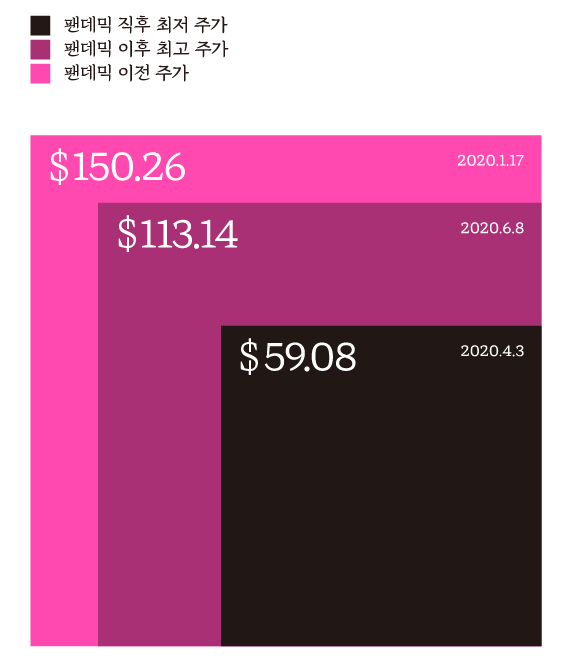
The hotel industry, like aviation, has been hit hard by the pandemic. Marriott International’s stock fell as much as 40% this year, but it has risen 94% since its March low. This, too, is due to demand for buying the dip.
Marriott International’s net income for the first quarter of this year was $31 million, less than 10% of the $375 million recorded in the same period last year. Net income plunged by more than 90%. On this news, the stock dropped by more than 30%, from $95 to $63. Marriott’s shares then fluctuated up and down before turning upward in June, along with news that airlines were resuming service. On June 8, Marriott traded at $113 a share, nearly double its March low. News that hotel occupancy rates were gradually rising after lockdowns were lifted also had a positive effect. Marriott’s 350 hotels in China were the first to reopen, and occupancy, which was around 7–8% in February, climbed to 40% in June.
In the US, too, with the summer vacation season, occupancy rose from 12% in April to more than 20%. Marriott CEO Arne Sorenson predicted that it would take several years to return to the pre-COVID average occupancy of 71%.
What to Change : Marriott offered special room discounts for health care workers at 2,500 hotels around the world. It has also introduced a variety of technologies, including facial recognition, and begun kiosk check-in.
Carnival Corporation & Plc.
Carnival Corporation & Plc.
Ask Americans what they most want to do after retirement, and many answer, “Take a cruise.” Traveling the world by cruise ship is a dream for many of them. In February this year, 700 passengers and crew members aboard the Japanese cruise ship Diamond Princess were infected with COVID, bringing cruises around the world to a halt and sending cruise companies’ stock prices plunging.
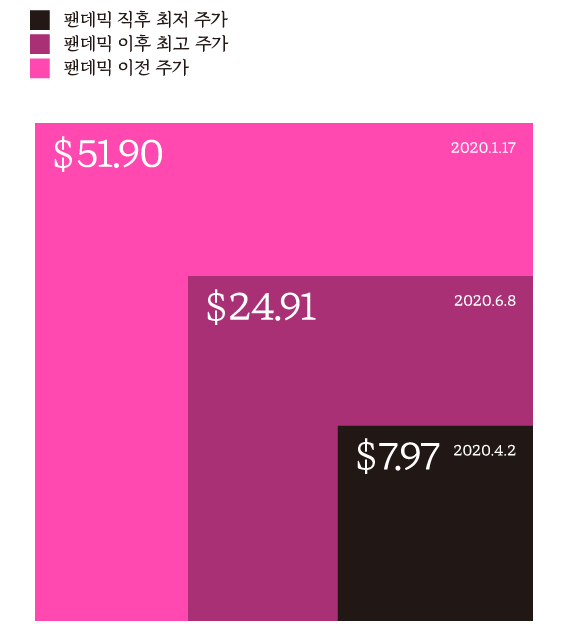
Carnival, a leading American cruise company, started the year at $51 a share, but as COVID began to spread, it collapsed 80% to $9.50 on March 18. The stock then fluctuated between $7 and $16 before recovering to $25 a share in early June on the announcement that flights would resume. Even so, it is still only half of its price before COVID spread.
Carnival had originally planned to resume service in August, but as a second wave of infections spread in the US, it postponed to September. In the wake of COVID, Carnival recorded losses of nearly 5 trillion won over the three months from March to May, and as conditions grew harder, it ended up selling six ships.
What to Change : When Carnival announced in May that it would take bookings for August, reservations jumped 600% over last year’s average within days.
That shows how strong Americans’ desire to travel is becoming. Even if cruises resume this fall, buffets are expected to be replaced by individually served meals, and shared facilities by a system of hourly reservations.
Uber Technologies Inc.
Uber Technologies Inc.
Uber’s stock has recovered to just about its pre-COVID level. It was cut in half, from $30 a share at the start of the year to $15 on March 18. Uber then pushed through the crisis with a post-COVID survival strategy. When its ride-hailing service plunged by more than 80% because of COVID-19, it used its existing drivers to launch a delivery service, Uber Direct. It also partnered with the public transit industry to begin letting users reserve public shuttle vans through the Uber app. It is an attempt to expand its business from ride sharing into public transportation.
Uber is also putting great energy into its food delivery platform, Uber Eats, because the number of Americans having food delivered to their homes has risen sharply since COVID. After a deal to acquire Grubhub fell through over a price gap, Uber acquired Postmates, the fourth-largest player in the industry, and is now competing with DoorDash for first place.
What to Change : As demand for contactless service grows, the in-app payment system, previously available only on Uber Black, is being extended to all Uber vehicles.
Booking Holdings Inc.
Booking Holdings Inc.
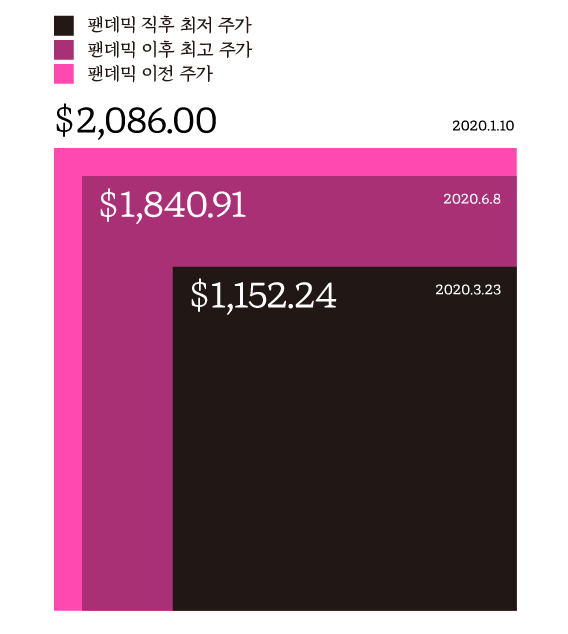
The stock of Booking Holdings, a travel reservation platform, also fell 56%, from $2,065 at the start of this year to $1,152 on March 23. As travel demand plunged, use of travel booking sites dropped as well. In the first quarter, bookings paid through Booking.com totaled $12.4 billion, about half of the $25.4 billion in the first quarter of last year. Revenue fell 19% from the first quarter of last year, and net income fell 69%.
Fueled by purchases from Robinhood investors, the American counterpart of Korea’s “Donghak ants” movement, the stock gradually continued to recover and climbed to $1,733 as of June 8. News that airlines would fully resume operations led individual investors to step up their buying. In fact, in the first quarter, major US hedge funds began buying Booking Holdings shares, saying the current price is attractive.
What to Change : In response to COVID, the company introduced a feature that provides information on accommodations that have completed disinfection. It offers real-time information in four categories for each property: safety facilities, cleanliness, social distancing, and food and beverage safety management.