
Long-Lasting Clothes — To Stay in Your Closet, for a Long, Long Time
Located in Hongje-dong, Seoul, Septic Tank is a sustainable fashion brand and concept store selling zero-waste lifestyle goods. An interview with founder Son Gippeum on making clothes designed to last.
Let's set aside the words ‘eco-friendly’ and ‘sustainability’ for a moment. What other words could describe this brand? An interview with Son Gippeum, founder of Septic Tank, a brand and zero-waste shop that extends the life cycle of products.
Words Parc Jinmyoung
Interviewee Son Gippeum (Founder, Septic Tank)
When discussing environmental issues, fashion can't be left out of the conversation. As many studies and statistics show, the fashion industry is one of the fields with the greatest environmental impact. Since the pandemic, fashion brands have all started talking about being eco-friendly, one after another. With sustainability-focused brands popping up like a trend, the sincerity behind them can seem a bit lacking. So how do they plan to solve the chemical byproducts generated during fiber cultivation, extraction, and fabric production, or the endless stream of clothing waste? Is simply not consuming really the only, and most eco-friendly, solution? With a mix of curiosity and skepticism, I arrived at Septic Tank, hoping that someone who both makes and loves clothes while caring deeply about environmental issues might offer a different perspective. Son Gippeum, who approaches sustainable fashion in a slightly different way, gave me a clear answer.
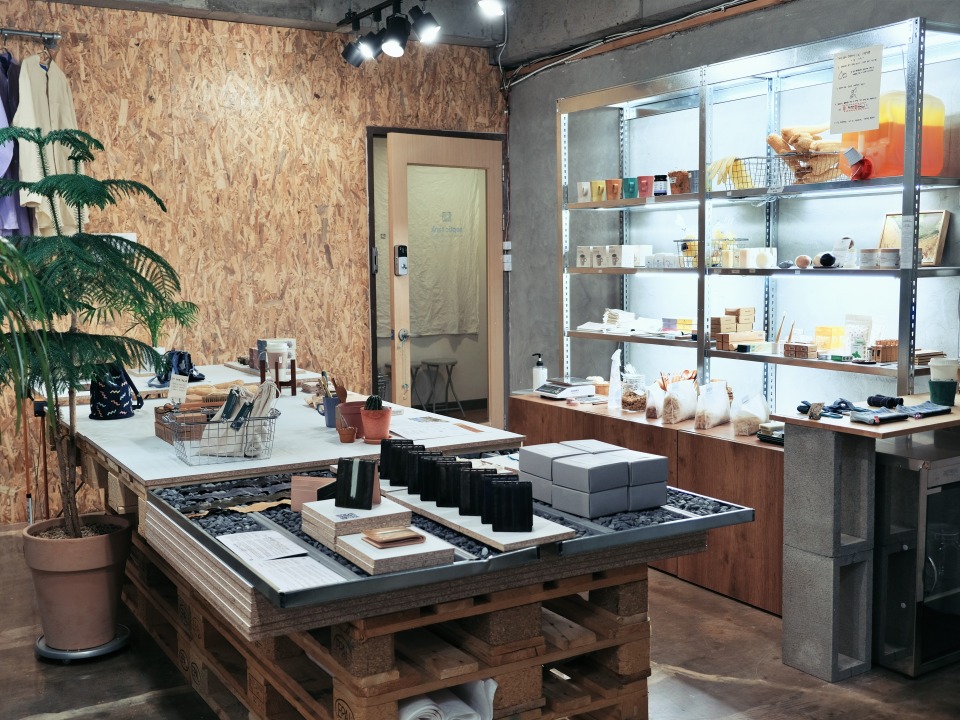
📝 Note 1. These days, eco-friendly brands are everywhere…
What led you to launch Septic Tank, a name that literally means a tank for wastewater treatment?
Right before starting this brand, I worked at a menswear brand handling customer service and shipping. That job made me directly witness just how much packaging gets thrown away every day. If even a small brand produces this much waste, I started wondering how much larger brands must be discarding — and I began to feel a strange sense of guilt. Looking at many domestic brands that sell clothes at reasonable prices, it seemed like both buyers and makers were focused more on quick consumption than on environmental awareness. I didn't want to be part of that. I wanted to make clothes in a different way.
You sold only online for six months before opening a physical store last October.
I figured if I just took the plunge, something would work out, so I started online. I wanted to create a brand that oversaw everything from making the clothes to disposing of them. I did take the plunge, but I later realized my starting point was off. The intention was good, and having a sense of the problem was a good start, but I hadn't thought enough about why people consume in the first place. These days, I think about it differently: first, make products that people genuinely need and that bring them happiness; then think about the environmental aspect; and finally, encourage people to join in along the way. It's not easy, but that's the direction I'm working toward now.
More and more brands are emphasizing sustainability these days, and even large corporations are moving in that direction. It might come across as a bit clichéd.
That's exactly why I try to avoid the term ‘eco-friendly brand’ as much as possible. We are a brand that thinks deeply about sustainability in our production process, but I'm still in the process of learning myself, and I want to build a brand that grows together with our customers. That's also why, when I opened the store, I stocked sustainable household items that I had personally tried and liked. I don't want to be a brand or a store that burns brightly once and then fizzles out. I'd rather keep a small flame burning steadily for a long time.
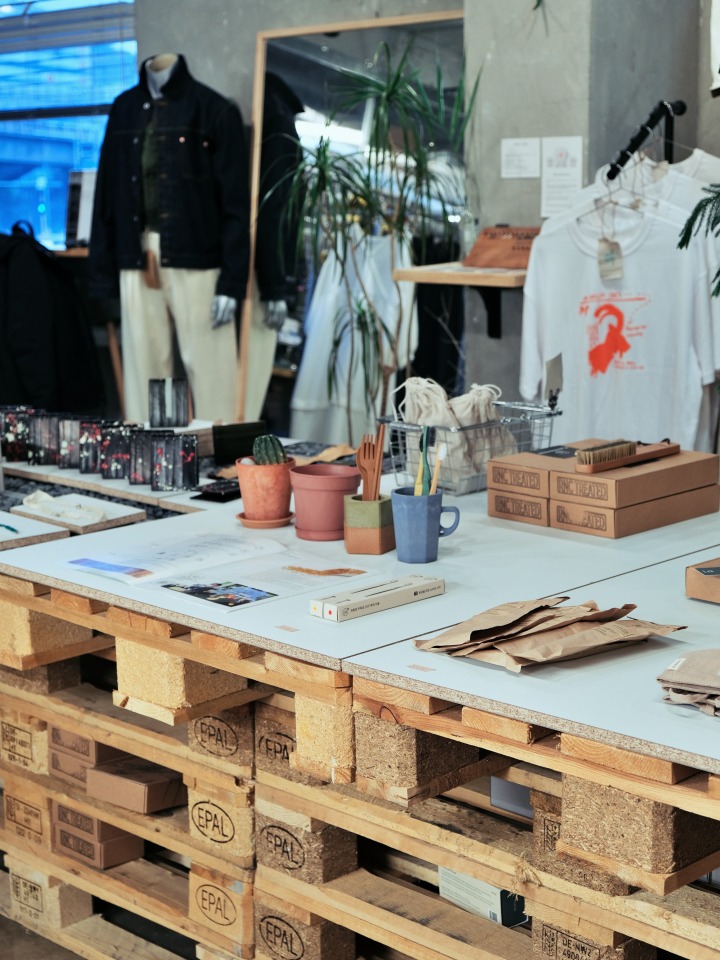
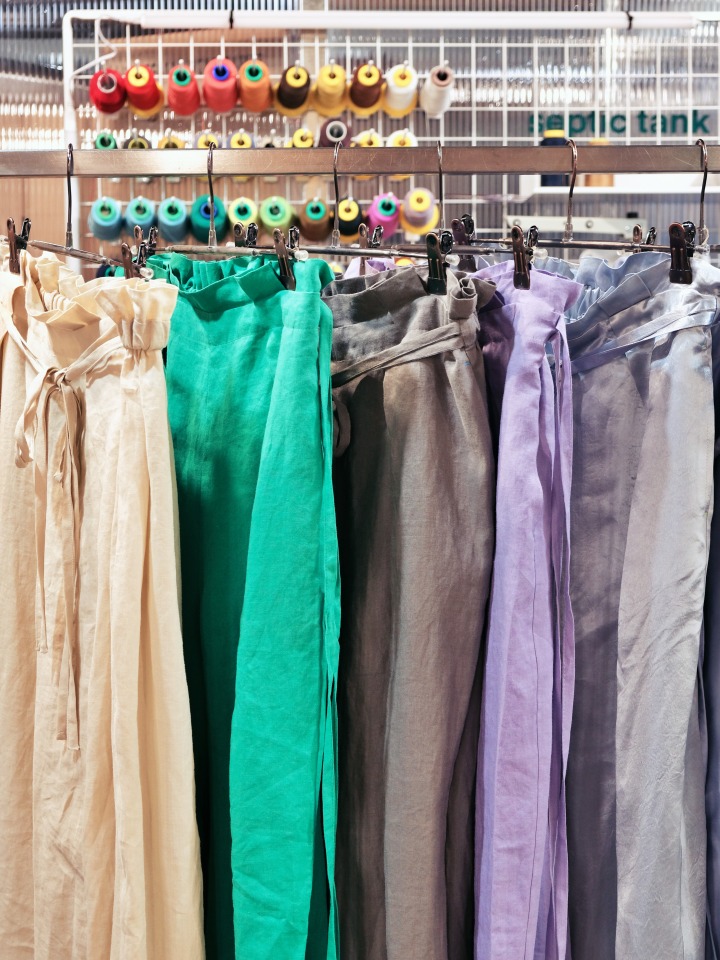
📝 Note 2. A neighborhood with the flowing Hongjecheon stream and warm neighborly ties
How did you end up settling in Hongje-dong?
I came here for the first time when I decided to open a store. Originally, I had Mangwon-dong in mind, but once I actually visited, I realized the commercial district there was already too developed, and it didn't quite suit me. To me, it felt like an ‘insider’ neighborhood already buzzing with people. (laughs) While walking along Hongjecheon stream, which stretches all the way to the Buam-dong area, in search of somewhere quieter, I discovered this neighborhood. The rent was affordable, the red brick buildings were charming, and the scenery was lovely. I signed the lease right away.
This is the kind of location only people who already know about it would find. Did you have confidence in the brand?
Quite the opposite, actually. I started selling online first, and even now I don't feel fully confident, and I'm still not satisfied with the level of completeness. But I settled here with a long-term mindset. My thinking was that if I used this space as a studio, kept studying, and gradually built up a solid system, customers would eventually find their way here. But there's still a long way to go. (laughs)
I noticed a poster for the ‘HONG (H.O.N.G) Project’ on your store door. It seems to be a project that shops in Hongje-dong came together to organize.
Septic Tank's very first customer was actually the café owner who organized this project. Whenever something new opens in Hongje-dong, he's the type to go around introducing himself to everyone — quite the social butterfly. (laughs) I was lucky enough to join this project, which brings together like-minded shops. The name is short for ‘Hope Our New Ground,’ and it's a local initiative where, if you visit all the participating cafés, grocery stores, and zero-waste shops in Hongje-dong, you receive nice, sustainable goods as a reward. The shop owners and I ride bikes along the stream together and share tea, building relationships rooted in a sense of shared hardship. I think they're a big part of what's gotten me through, day by day.
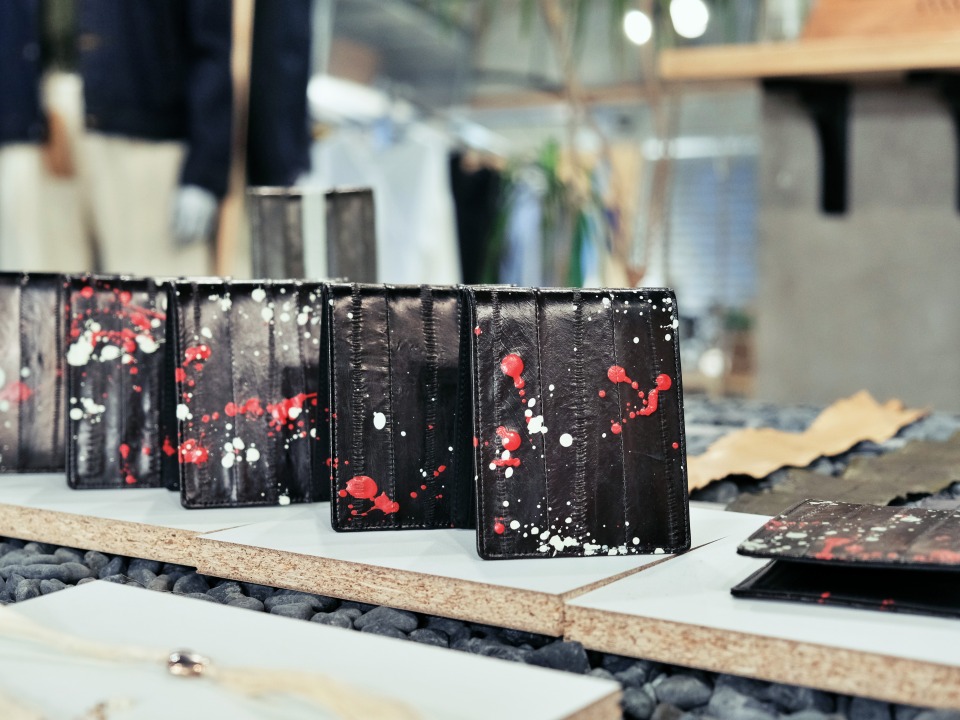
📝 Note 3. Something beyond upcycling.
How are Septic Tank products made?
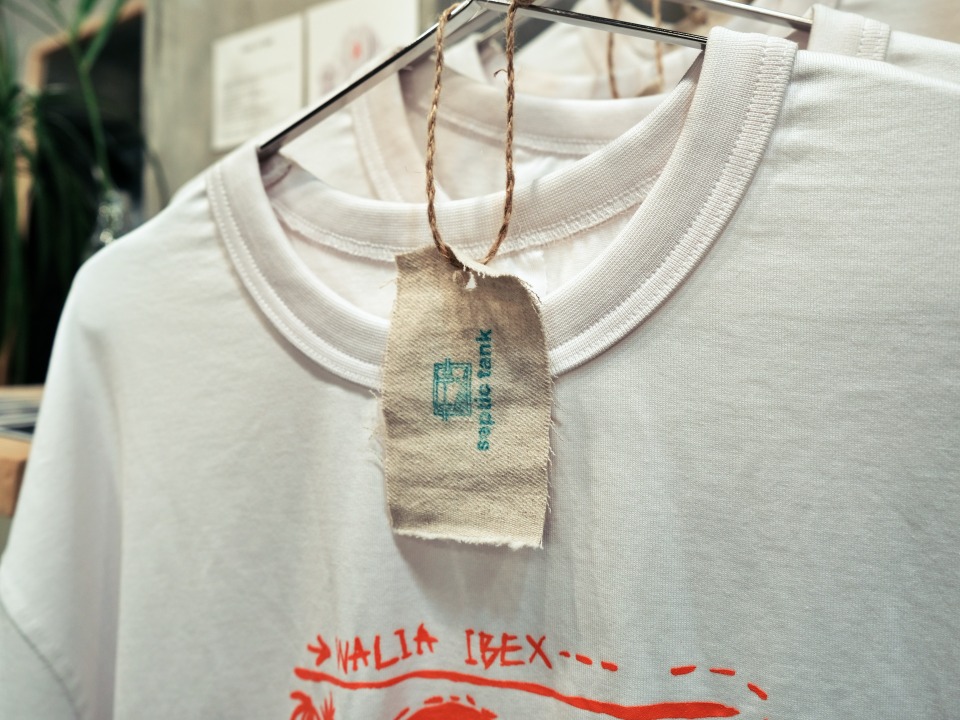
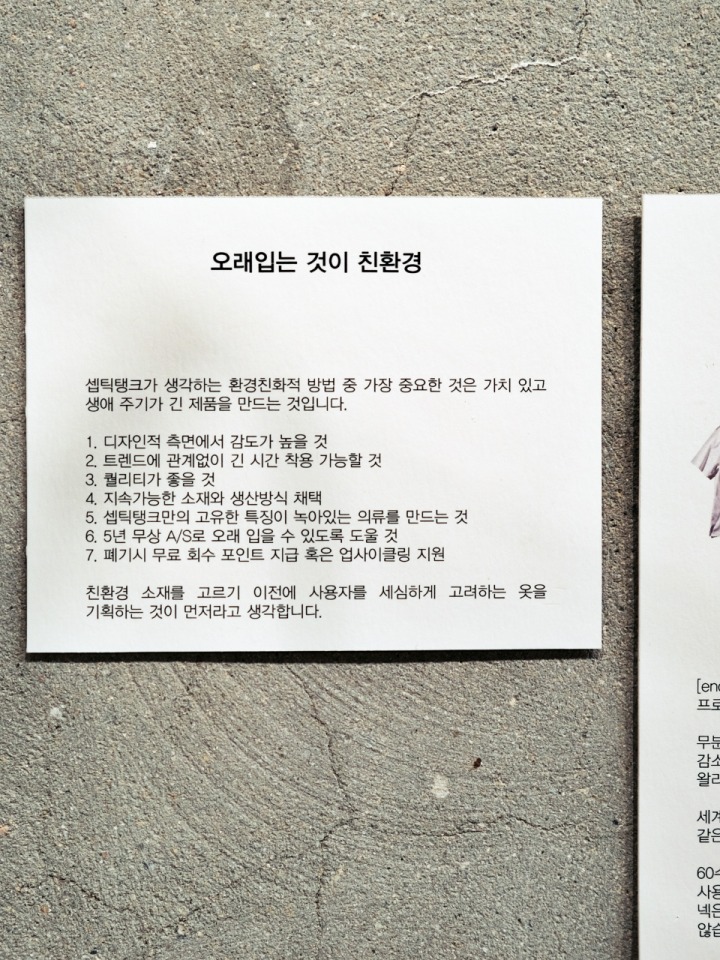
Rather than releasing products every season, we make clothes around specific ‘quests.’ These quests vary widely — for example, military upcycling, printed T-shirts featuring endangered species, or sweatshirts made from leftover stock through collaborations with other brands. All Septic Tank clothing comes with five years of free repair service. And when a piece of clothing has served its purpose and is ready to be discarded, we collect it for free and upcycle it again. You could call it a circular brand.
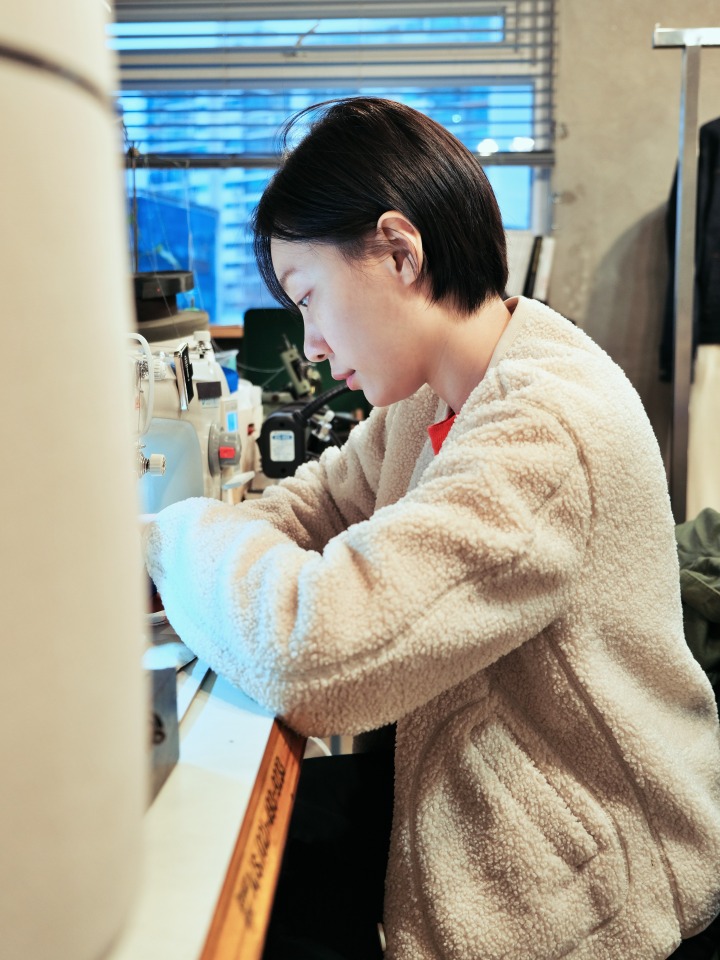
I've dreamed of being a fashion designer since I was young, and I've always had my own standards for what kind of clothes I love. That led me to separately launch a brand called Microbe, which delivers messages to people through clothing. This brand uses biodegradable fabrics and materials for more than 70 percent of each product. Like Septic Tank, it also offers free disposal service. Above all, we focused on the essential function of clothing — maximizing comfort so the wearer looks their best, while minimizing anything that feels artificial. Our signature product is a setup you can grab without a second thought; aside from the thread, 98 percent of the materials come from nature. We used ramie fabric, which is finer and softer than linen.
As you develop Microbe, it seems like you're exploring various eco-friendly methods beyond upcycling.
I had been searching for leather alternatives for a while. In Italy, I found that they make leather out of grape seeds. I was very interested in that, but due to various circumstances, that material was hard to source, so instead I found eel skin. After eels are sold for food, the skin — one of the byproducts — can be used as a leather substitute. It's completed through a special process: the naturally dried eel skin is flattened by hand piece by piece, individually cut, and then stitched back together. Eel leather is thin, soft, and light, and it's about 1.5 times more durable than cowhide, giving it great longevity. We then paint it with dyes that have passed environmental testing. It's not easy, but I think it's a necessary process if you want to create something that will stay with someone for a long, long time.
As you keep learning, the gap between reality and ideals must feel pretty large.
Honestly, more important than using eco-friendly materials is eliminating excess inventory. That's really not easy, since mass production is the best way to keep unit costs down. So far, I've outsourced to factories or made things myself with a sewing machine, but I'm planning to try crowdfunding for production. Crowdfunding seems like a great way to minimize inventory while also effectively conveying our message.
Is there an ultimate message you want to convey through this space and brand?
Actually, I majored in fine art. But I found that having something tangible influence someone's lifestyle brought me a much greater sense of accomplishment than simply having people appreciate art. Fashion became that medium for me. Through Septic Tank, I want to create objects and a culture that are closely woven into people's everyday lives. I hope people buy our products not simply as eco-friendly substitutes for something else, but because they believe these items will make their lives richer and happier.
📝 Note 4. As expected, like a sparrow drawn to a mill, I couldn't resist opening my wallet.. I ended up buying the one-tuck pants, made from natural cotton produced by Kuroki, Japan's renowned denim factory. As Son Gippeum handed me the pants, she said she hoped I'd wear them until they were worn and frayed, and that in 20 years, she'd even upcycle them for me. That single remark captured the essence of this long conversation — along with her wish to make clothes that stay in someone's closet, for a long, long time.


