Like a Twisted Doughnut — On Writing and Travel
We interviewed Choi Minseok, a novelist and traveler who writes “travel ficsay,” a blend of travel essay and fiction. He talks about the challenge of the form, his influences, and why he always heads somewhere new.
Like a Twisted Doughnut — On Writing and Travel, Twisted Like a Doughnut
Wherever he travels, novelist Choi Minseok keeps eating, running, and writing. He readily joined * “Pitch by Magazine”’s new experiment, the “travel ficsay,” which combines travel essay and fiction. This is our inevitable meeting with him.
Interviewer Pitch by Magazine
Photos Park Shinwoo
Interviewee Choi Minseok
* From the inaugural issue through Issue 4, “Pitch by Magazine” serialized novelist Choi Minseok’s travel ficsay series “Case Files” over four installments. Part 1, Case File ‘Bogota Morning Dew’; Part 2, Case File ‘Trump Hotel’; Part 3, Case File ‘Naples Rental Car’; Part 4, Case File ‘Hunter of Love’.
?1
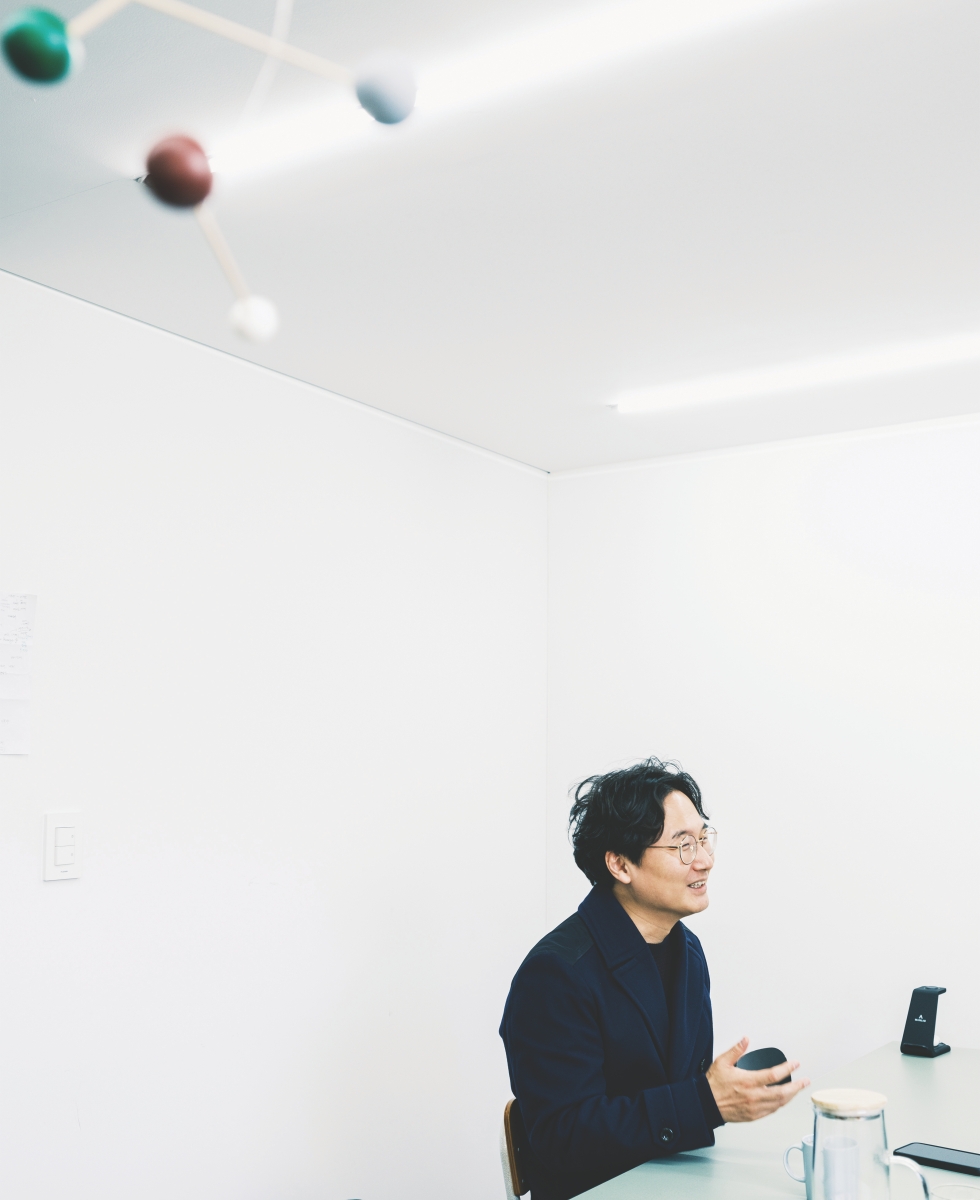
Traditionally, travel essays are considered nonfiction, and readers take them as true stories rather than invention. When “Pitch by Magazine” asked you to write a ficsay, did you immediately know how you would approach it?
No, it was really hard to write. When a writer gets a commission, of course it’s welcome and I’m grateful. I’ve said this many times before: it’s a wonderful thing when someone gives a writer a reason to write. But apart from that, a ficsay has to capture the strengths and charms of both fiction and essay. If it leans too far toward fiction, it becomes absurd; if you only write what you’ve actually experienced, as in an essay, it loses the fun of fiction. So the difficulty lies in how to blend the two in the right proportion. Once I actually sat down to write, I found myself agonizing over it. I wanted to depict something that isn’t common in everyday life or on the road, but is still plausible, something that could happen once in a blue moon, and to do it in my own style. With that in mind, I managed the first two pieces well enough, but from the third one it got really hard. I wrote the fourth by wringing it out of myself. My conclusion is that the world of the ficsay is by no means easy. It has to be persuasive while also guaranteeing enjoyment, so it’s an extremely subtle and delicate territory.
And honestly, the length was difficult, too. To add the fun of fiction to an essay, you need something close to short-story length (80 to 100 pages of 200-character manuscript paper). But because it’s a magazine piece, I had to consider readability and fit a full arc, with beginning, development, turn, and conclusion, into 50 to 60 pages, and that was hard, too. Standing on the border between fiction and essay is hard because of the nature of the genre, and the length is hard because of the format. In the end, both content and form were difficult. Writing a single story at that length was a new challenge for me as well. It was fun. Looking back, it’s always a good and enjoyable experience.
Have you visited every place that appears as a setting in your work?
I’ve been to all of them except Texas. I just never went to Texas, but I’ve been to Florida, Mississippi, and Tennessee. I think the fourth piece is the one set in Texas. In that piece, the story that takes place in Portland is something I actually experienced. I really did stay at an Airbnb Superhost’s home in Portland, and at the park where I’d gone running, I happened to meet the host out walking his dog. On the way back we chatted about this and that. He asked, “What do you do?” I said, “I’m a writer from Korea, and I came here to write a book.” “Then you could come to America and write here.” “Right.” “I have a friend from Italy who married an American man and is now a citizen. But she got divorced and lives alone, and she’s lonely. Would you be willing to meet her? If you marry her, you’d get citizenship.” That’s what he said. So I told him I was already married, a newlywed, and he said, “Then if you know anyone around you who speaks English like you, wouldn’t mind living in America, and wants citizenship, please introduce them to me.” That gave me the inspiration for the last episode. A junior colleague I met when I was an exchange student still lives in the US. That colleague’s friend has the English name Kevin. I mixed a lot of things like that together.
?2

When you first started writing, did you have a role model or a style that influenced you?
I was influenced by almost everything I came across. I’ve loved movies since I was a child, so I naturally absorbed things about narrative. Writing is ultimately about telling a logical story in an entertaining way, and for that part I was influenced more by social science books than by novels. Writing papers as a student helped a great deal. I believe that if you write an academic paper in an entertaining way, it becomes a novel. Movies, music, and then social science books. Literature goes without saying. All of it is mixed together. Here’s an example. In a James Bond film, Bond goes through a big action sequence first, and only then does the opening title sequence come. You learn that kind of structure. The first sentence or first paragraph needs impact, and then you shift the mood and start anew. Seen that way, a novelist isn’t influenced only by novels; music, film, and art can all be influences. When I made up my mind to write, the influence was direct, but even when I wasn’t seriously thinking about writing, I was consuming all sorts of things while growing up, like an omnivorous animal. All of popular culture, social science, even academic papers got lumped together, and perhaps that’s how my own strange B-movie sensibility came about…
How much of a role does travel play in all that?
A very large one. These days, a writer is ultimately a digital nomad. With just one laptop, or paper and a pencil, you can write anywhere. When I went to Machu Picchu near Cusco, Peru, I even wrote with a ballpoint pen on a map and on the back of a receipt. A writer can get ideas and inspiration wherever he goes, which is a tremendous blessing, and I tried to make use of it. If you keep writing in the same place, your motivation sometimes flags. You can fall into a rut out of sheer habit, and when that happens, going on a trip gives you wonderful energy.
How does a change of place affect your writing?
Honestly, if you have powerful concentration, you’re not affected much. Figuratively speaking, you could write even under a waterfall. But living as a full-time writer means you have to keep writing within your daily life, too. I’ve been a writer for over ten years now, so writing has become part of my everyday routine, and I can’t help but be affected by space. So, paradoxically, I prefer a space that doesn’t affect me: somewhere that isn’t noisy, somewhere that isn’t splattered with blood on every side. Because we’re influenced by space, I think the most important thing is that the space doesn’t get in my way. Follow that logic and you end up needing a separate space of your own, which connects back to the question of concentration. Without a supervisor, you slack off and play. In the end, as long as the space is good enough not to disturb me, the rest is a matter of will.
?3

Do you have criteria for choosing a destination?
My criterion is very clear. The biggest purpose of my traveling is to satisfy my curiosity and explore the unknown, so a place I’ve never been is always my first choice. Of course, if I go once and love it, I might go again, but that’s when I’m going to work or rest. When I want to gain new energy and broaden my horizons, I always go somewhere I’ve never been.
You say you go to places you’ve never been, but don’t they sometimes turn out to be similar once you get there?
Often. Wherever you go, there’s a Starbucks and a McDonald’s. Europe in particular: every city has a square at its center, with government offices, shops, and a library around it. And it’s not only Europe. South America, which was colonized by Europeans, is the same. They’re all alike. Still, no matter what, the language is different, the local food is different, the weather is different, the scenery is different. For a traveler, the most important thing is a mind, and an ability, to be astonished. A teacher I respected as a student used to say, ‘A person who has the ability to be amazed is a person of real ability.’ No matter how wonderful the things you see, if you think they’re all the same, there’s no joy in living and no motivation. That said, making a fuss over the most minute differences would be a problem, too. What matters is not growing indifferent when you see something that is clearly different. I think that’s extremely important for someone who writes. Otherwise everything is the same. White is the paper, and black is the type. But the whole universe is contained in the sentences that those consonants and vowels create, so you need a discerning eye and an eye for the new, one that can find fun and emotion inside them.
It’s been quite a while since the pandemic stopped you from traveling. What surprised you on your most recent trip?
My last trip was forty days in South America. There were several surprises… In Cusco, I picked my lodging after reviewing it very carefully, in my own way, but when I got there it turned out to be a semi-basement room. And its layout was so similar to the boardinghouse room where I stayed as a student. I thought I’d chosen so carefully, so why did it turn out like this? Maybe it’s karma from a past life. No matter how far up to ground level a person climbs, he goes round and round and eventually returns to where he began. That’s what I thought. Still, remembering my student days made me feel young again, and I liked that, even though my body was clammy from the humidity.
?4

In several earlier pieces, you’ve made no secret of your love for spy stories and for travel. What do secret agents and travelers have in common?
I believe that when a writer writes about something they love, they get excited, and that excitement carries over to the reader. So I try to write about what I like. The more you like something, the more you learn about it, and the more you learn, the more credible you become. What travelers and spies share is that both put on a mask. A spy becomes a different persona in a foreign land, right? It’s similar when we travel. In Seoul you’re Assistant Manager Kim or Junior Staffer Choi, but in Sicily you don’t need to be. So your true self might come out, or you might become ‘a Coreano traveling through Sicily.’ You’d never behave that way in Seoul, but suddenly you’re this wildly free spirit who might start dancing when a song comes on. When you travel, every place you go shapes you, and you become a slightly different person. Spies are the same. If that counts as common ground, then that’s it.
What kind of traveler are you?
I’ve done most of my traveling alone. When you’re alone, you can’t chat with strangers as you wander, and you can’t even talk to yourself, so you turn contemplative whether you mean to or not. Your thoughts pile up but there’s no outlet, so you run, listen to music, or pull out a notebook and scribble for no reason. And then you decide to write something like **“Berlin Diary.” In Seoul, I can barely keep up with the pieces I’ve been commissioned to write, so I wondered why I write things nobody asked for when I travel. I think that when you travel, you end up doing what you truly want to do, or what you can’t help but do. For me, it comes down to three things: in the morning, a cup of coffee, a run, and writing; in the evening, rest or a drink. Honestly, that’s the life I actually want to live. I don’t do it in Seoul, my everyday setting, but when I travel, I work on my manuscript in the morning. After 1 p.m. it’s too hot, so swimming is the only option. I swim, then read. Around 4 it gets a little cooler, so I run. In the evening, I rest and listen to music. I rented a place and stayed for a long time; there was nothing much to spend money on, and no way to earn much either. It was just right in many ways. The manuscript I revised back then was ***“The Taste of Kkwabaegi” (kkwabaegi are Korean twisted doughnuts). I’d originally gone to write a novel, but it was so hot that the novel wouldn’t come, so I revised an essay manuscript I already had and published that instead.
In that book, you said you wanted to write “something like a kkwabaegi.” What would a kkwabaegi-like journey be?
“It’s not food made by some great chef. You can find it on the street and at the market, and if it catches your eye while you’re walking, you can grab a bite easily. But when you think about making it yourself at home, you hesitate. So when you see one someone else has made, you pick it up now and then. That’s a kkwabaegi. I’m neither a master calligrapher nor a master stylist, but I want to write something you think of from time to time, something that makes you say, ‘Oh, this guy has another book out,’ when you spot it in a bookstore. Writing it yourself feels embarrassing, and you don’t really want to write like this, yet you want to read it once in a while. The charm of that kind of essay is the taste of a kkwabaegi.” That’s roughly what I wrote. Back to travel writing: in Berlin I want to see good things, eat good food, and have good experiences (and the same goes for South America), but I’d also like someone to take a trip like this and make my leisure time a little more fun. I’d like someone to travel like this on my behalf. I think that’s what a kkwabaegi-like journey, a kkwabaegi-like travelogue, would be.
** “Berlin Diary,” Choi Minseok, Minumsa. A collection of diary entries written every single day during a 90-day residency program in Berlin, starting in the fall of 2014.
*** “The Taste of Kkwabaegi,” Choi Minseok, BooksTone. A revised edition of the 2012 essay collection “An Epic of Youth, Wandering, Frustration, and Tears,” published in 2017 together with its sequel, “The Style of Kkwabaegi.”
?5
“Berlin Diary” and ****“40 Days Around South America” were published about five years apart. (“Fitzgerald” came before the South America book.) What changed for you, as a writer and as a traveler, in between?
As a writer, my drive faded. I had little drive even when I wrote “Berlin Diary,” and after that it drained away even more. I can’t speak for other writers, but I can write essays only when I loosen my shoulders and strip away the froth. An essay is, after all, writing in a domain I can’t control. In a novel, I can bring a character to life or kill them off, make them meet or miss each other. But an essay is based on what I’ve experienced, so no matter how determined I am when I go somewhere, I can’t control what happens to me there. That’s why I empty my mind when I write essays, especially travelogues. I tell myself to write calmly. For example, when I go to Mexico, planning to experience this in Mexico City and that in *****San Cristóbal de las Casas is my reporting plan. Whether something unexpected happens there or nothing happens at all is what actually occurs. However good the plan, an essay rarely goes according to it, so even when I receive an advance for a book, I don’t spend it. I just leave it in my bank account, because if the writing doesn’t come, I’ll have to give it back.
“A sucker’s journey.” That’s the thought that keeps coming to me when I read your travel essays and fiction-essay hybrids. With each trip, the protagonist gets caught up in one mishap after another and becomes a bigger sucker. Is there a meaning you want to convey through this “sucker”?
I think that’s beyond my control; it’s in the realm of the gods. The best thing about becoming a writer is that even when something unfortunate happens to me, at least I’ve gotten one piece of material out of it. I do go through a lot of misfortune. Right before today’s interview, I lost my credit card and had to report it. Before I became a writer, I got very stressed by things like that, but now, even when something unfortunate happens, I think, ‘Well, I’ve picked up another story today.’ Someone once told me to get an upper endoscopy without sedation. They said it would make great material. So I tried it. I thought I was going to die. The person who told me that was my mother-in-law. The owner of my regular café tested positive for COVID and was quarantined in a facility for several weeks. When he came back, he told me it was an experience every writer should try at least once. Whenever something unfortunate happens to them, everyone makes a point of telling me. Anyway, I think I’ve developed the attitude of not treating misfortune as misfortune, since everything can become material. But plenty of good things happen in my life, too. I just don’t write about them.
Why not?
Because I’m afraid readers would get jealous. Literary fiction has always been about failure and suffering. It’s not a self-help book.
**** “40 Days Around South America,” Choi Minseok, Haenaim. A travel essay recounting a journey through six countries, from Mexico to Colombia, Peru, Chile, Argentina, and Brazil, told with the author’s signature humor.
***** A city in the highlands of Chiapas, a state in central Mexico.
?6
One last question. What role can a novelist’s work play in making travel more sustainable?
A novelist is someone who creates, so I suppose I could create something out of this subject. Now and then I think about shaping a dystopian situation with a bit of humor. Say a ban on disposable wooden chopsticks is announced: “An age has arrived in which the exchange value of a pair of wooden chopsticks exceeds ten carats of diamonds. Anyone found with wooden chopsticks at home is sentenced to life in prison. Yet among chopstick enthusiasts, adventures and secret deals run rampant as they hunt for the last surviving pairs.” You can add imagination to a premise like that. But honestly, what matters more than writing is becoming one person who travels sustainably. Writing is talking, it’s expressing. Putting it into practice matters far more than that. Better to practice without expressing than to express without practicing. “Shut the mouth, do it.”